Entry-Level Physician Assistant Salary in Madison, AL: $78,976 (2026)
Quick Answer:New physician assistants entering the Madison, AL job market in 2026 can expect a starting salary around $78,976 (BLS 10th-percentile benchmark for SOC 29-1071, projected from 2025 OEWS data). Stripping out Madison's local price level (BEA RPP 87.9 — 12% below national), a first-year paycheck buys what $89,848 would in average-cost America. Most reach the city median ($105,193) within a few years of clinical practice.
Based on BLS state-level estimates · View source
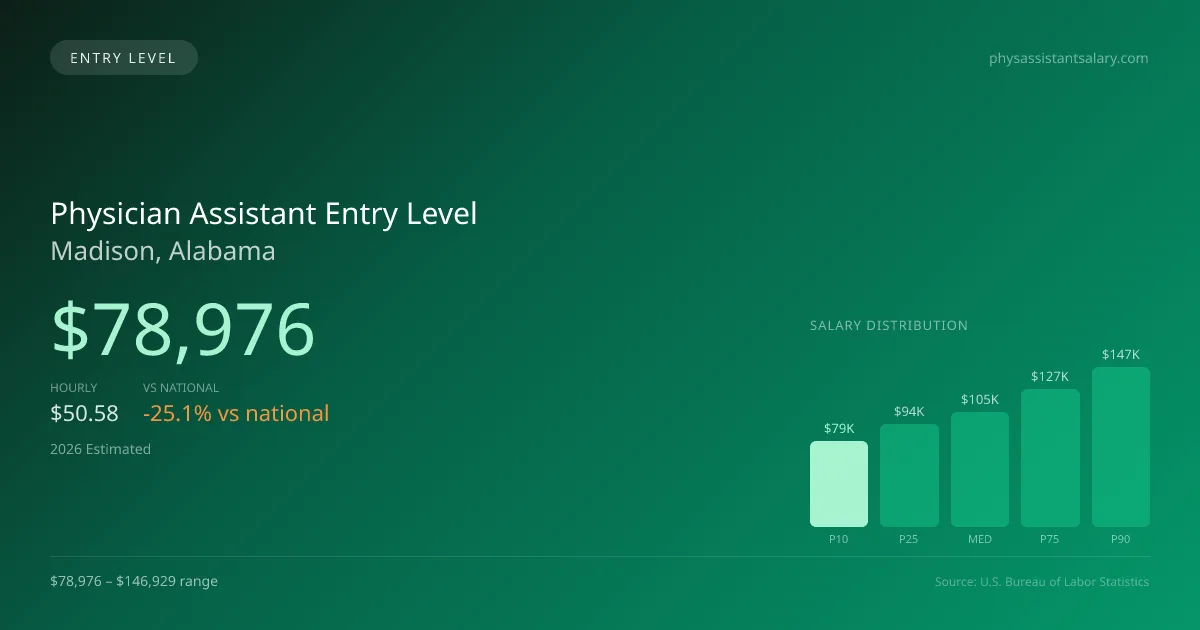
For new graduates entering the physician assistant field in Madison, Alabama, the starting compensation is a critical consideration, especially in light of the projected entry-level salary range in 2026. With a minimum potential salary of $78,976, recent graduates can expect to begin their careers at a level significantly below the city’s median annual salary of $105,193. This gap indicates that, while early career earnings may be modest, they can grow substantially over the first few years, moving through the 25th percentile at $94,161 and potentially reaching the city's median as experience is gained. Overall, Madison currently presents a reasonable market for newly minted physician assistants, particularly as they look toward advancing their pay in a profession that regularly sees wages rise as practitioners accumulate experience.
About the Madison Market
Salary estimated from Alabama average ($112,000) adjusted for local cost of living.
Career Earnings Timeline in Madison
New Graduate
Early Career
Mid Career
Experienced
Salary progression estimated from BLS percentile data. Actual progression varies by employer, certifications, and specialization.
2026 Salary Percentile Distribution in Madison
Entry-level physician assistants in Madison, AL typically start between $78,976 and $94,161 per year (2026 est.). The full salary range spans $67,953 from the 10th to 90th percentile, with the local median at $105,193 — 25.07% below the national median.
Return on Investment
The average physician assistant program cost in Alabama of $55,000 represents just 69.64% of the starting physician assistant pay ($78,976/year) in Madison. Most graduates begin earning back their investment from day one, though actual ROI varies based on living expenses, loan interest, and the 2-year opportunity cost of schooling.
Program cost estimates based on ARC-PA accredited master's-level PA programs. Most PA programs run 27-30 months and include didactic and clinical rotation phases. Public in-state programs are the most affordable option; private programs in high-cost metros can approach $150k. Totals reflect tuition and program fees only; PANCE certification exam fees are separate.
PA Salary Negotiation Tips for New Graduates in Madison
- 1Research the Madison market: entry-level physician assistant pay ranges from $78,976 to $94,161, so aim for at least the 25th percentile if you have strong credentials.
- 2Highlight any additional certifications or specialty training within the physician assistant field — employers in AL often pay a premium for expanded scope of work.
- 3Evaluate the full compensation package — in Madison, benefits like health insurance, continuing-education allowances, and schedule flexibility can add 20-30% to your effective compensation.
- 4Consider starting with a larger hospital system or multi-site employer in Madison for competitive entry-level pay and structured mentorship, then move to a smaller employer once you have 2-3 years of experience.
- 5Madison's below-average cost of living means your starting salary goes further here compared to many larger metro areas.
Physician Assistant Compensation Range
The physician assistant wage spread in Madison is $67,953 ( 86.04%) between entry-level and top earners. Starting at $78,976, experienced hygienists can earn up to $146,929.
Represents the current salary spread across experience levels, not projected career growth rate.
2019 BLS Actual
$55,932
2025 BLS Actual
$76,438
2026 Current Est.
$78,976
2019–2027 Growth
+45.9%
Salary Trajectory for Physician Assistants in Madison (2019–2027)
2019–2025: actual BLS OEWS data for this metro area. 2026+: CAGR 3.32% projection.
| Year | Annual Salary | Status |
|---|---|---|
| 2019 | $55,932 | Actual |
| 2020 | $58,994 | Actual |
| 2021 | $59,947 | Actual |
| 2022 | $64,470 | Actual |
| 2023 | $66,362 | Actual |
| 2024 | $70,462 | Actual |
| 2025 | $76,438 | Actual |
| 2026(current) | $78,976 | Estimated |
| 2027 | $81,598 | Projected |
Entry-level physician assistant compensation (10th percentile) in Madison, AL grew 36.7% over 7 years based on actual BLS metropolitan area surveys, rising from $55,932 in 2019 to $76,438 in 2025. By 2027, starting salaries are projected to reach $81,598. New graduates entering the Madison job market can expect continued year-over-year gains.
Note: Historical values (2019–2025) are actual BLS OEWS figures for the Madison metropolitan area, sourced from annual Occupational Employment and Wage Statistics surveys. 2026–2026 figures are current estimates, and 2027 values are projections, calculated using a 3.32% CAGR derived from 7-year BLS historical data. Actual salaries may vary based on employer, experience, certifications, and local market conditions.
Starting Your physician assistant Career in Madison
In Madison, employers tend to favor hiring new graduates for positions in primary care and urgent care settings, where structured onboarding processes are common. These entry-level roles are beneficial for young professionals, as they often provide foundational experience in patient care protocols and technological systems. In addition, candidates holding an ARC-PA accredited Master’s degree and NCCPA national certification (PA-C) can start on a solid footing, particularly in today’s labor market. Continuing education and credentials such as a state PA license and DEA registration are crucial for upward mobility. The first three years in a PA role present opportunities for career advancement, especially for those who specialize in high-demand areas like orthopedics, where first-assist billing capabilities yield higher pay rates. Salaries in these roles typically see notable increases as PAs refine their skills and capitalize on collaborative practice agreements, thus enhancing their earning potential in a state that increasingly emphasizes Optimal Team Practice principles post-2020.
More salary data for Madison, AL:
Frequently Asked Questions
What is the starting salary for physician assistants in Madison in 2026?
How fast do physician assistant salaries grow in Madison?
Is physician assistant school worth it in Madison?
What do new physician assistants make right out of school in Madison?
How do I become a physician assistant in Alabama?
Related Pages
Compare Salaries
Career Resources
Nearby Cities in Alabama
Written by Jessica Tran, MPAS, PA-C
Career Analyst
Jessica has 10 years of experience as a physician assistant. Her specialty is cardiology in an outpatient setting.
Methodology & Data Source
Entry-level salary figures on this page are 2026 projections based on the Bureau of Labor Statistics Occupational Employment and Wage Statistics (OEWS) survey, May 2026 release. The 10th percentile (entry-level) is used as the starting salary benchmark for new physician assistant graduates. A 3.32% compound annual growth rate (CAGR), derived from 6-year national BLS wage trends, was applied to project current 2026 entry-level compensation in Madison. Program costs are averages and actual tuition varies by institution. ROI calculations are simplified estimates.
Data Sources & Methodology
Salary data for Madison is estimated from official BLS state-level occupational wage data (2025), adjusted for regional cost-of-living differences using BEA RPP (Regional Price Parities).
2026 figures are projected from 2025 BLS data using a compound annual growth rate (CAGR) of 3.32%, derived from historical BLS wage trends for physician assistants (SOC 29-1071).
Compiled and verified by Jessica Tran, MPAS, PA-C, a licensed physician assistant with 10+ years of clinical experience. · View source data at BLS.gov